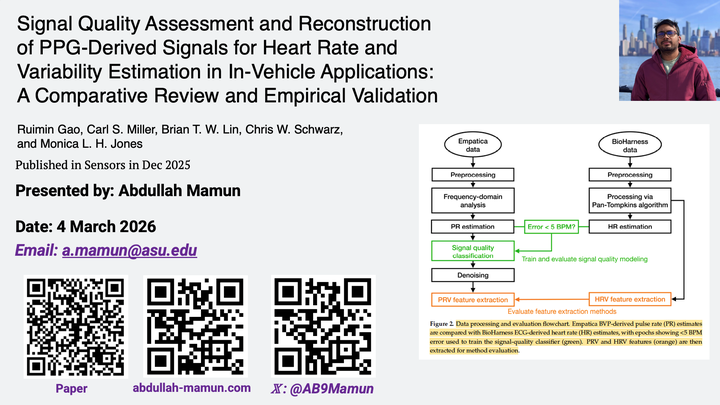
Signal Quality Assessment and Reconstruction of PPG-Derived Signals for Heart Rate and Variability Estimation in In-Vehicle Applications: A Comparative Review and Empirical Validation
Abstract
Electrocardiography (ECG) is widely recognized as the gold standard for measuring heart rate (HR) and heart rate variability (HRV). However, photoplethysmography (PPG) presents notable advantages in terms of wearability, affordability, and ease of integration into consumer devices, despite its susceptibility to motion artifacts and the absence of standardized processing protocols. In this study, we review current ECG and PPG signal processing methods and propose a signal quality assessment and reconstruction pipeline tailored for dynamic, in-vehicle environments. This pipeline was evaluated using data gathered from participants riding in an automated vehicle. Our findings demonstrate that while blood volume pulse (BVP) derived from PPG can provide reliable heart rate estimates and support extraction of certain HRV features, its utility in accurately capturing high-frequency HRV components remains constrained due to motion-induced noise and signal distortion. These results underscore the need for caution in interpreting PPG-derived HRV, particularly in mobile or ecologically valid contexts, and highlight the importance of establishing best practices and robust preprocessing methods to enhance the reliability of PPG sensing for field-based physiological monitoring.

Abdullah Mamun
Graduate Research Associate
Currently I am working on building and optimizing deep learning models for time-series data.